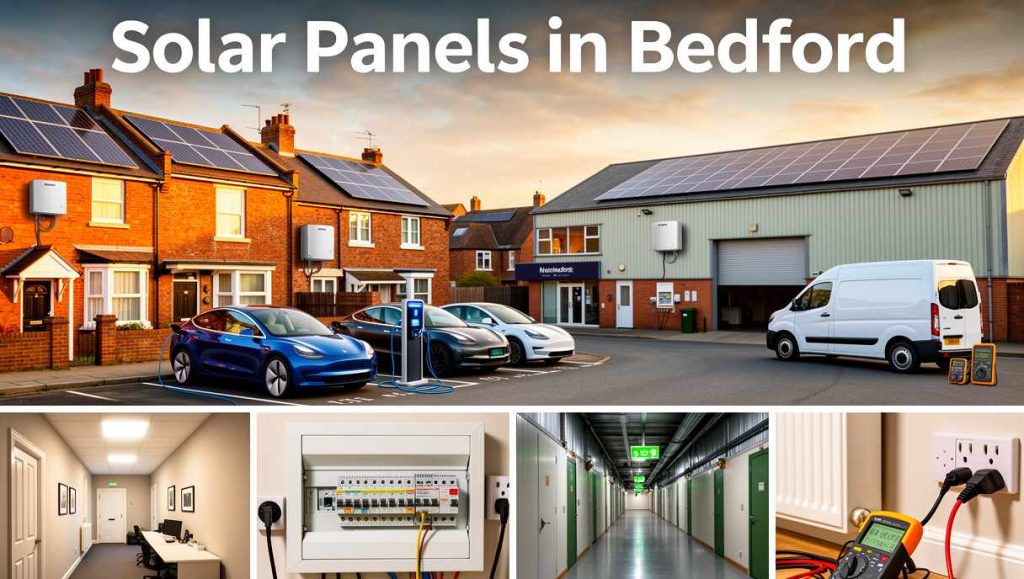
Solar Panels in Bedford: Cut Bills, Boost Resilience, and Go Greener
Bedford is perfectly placed to benefit from modern solar technology. With strong sunlight yields for the UK, fast-rising energy costs, and improved incentives, households and businesses are turning to solar panels and battery storage to protect against price volatility while shrinking carbon footprints. Whether it’s a family home in Brickhill, a shop on the High Street, or a warehouse on the outskirts, well-designed systems deliver dependable savings, cleaner energy, and long-term value across Bedford and the wider Bedfordshire area.
Why Solar Panels Make Sense in Bedford
Sunlight in Bedfordshire is better than many expect. A typical rooftop system in the area can generate a sizeable share of a property’s annual electricity needs, with many homes offsetting daytime usage and charging batteries for evening consumption. Year on year, that translates into substantial reductions in grid demand and bills, while producing low-carbon energy right at the point of use. For businesses, the benefits are amplified: daytime operations align with peak generation, helping to smooth overheads and improve sustainability reporting.
Policy and market shifts reinforce the financial case. The UK’s Smart Export Guarantee (SEG) allows owners to sell surplus electricity back to the grid at variable rates, and domestic installations benefit from zero VAT on eligible energy-saving materials. With time-of-use tariffs becoming increasingly common, combining panels with battery storage can further optimise savings—charging when rates are low or sunlight is free and discharging during expensive periods. Over a system’s 20–25+ year lifespan, these strategies can materially improve overall returns.
Planning rules also favour adoption. Most roof-mounted Solar Panels in Bedford fall under permitted development, provided arrays are not higher than the roof ridge and do not project excessively from the slope. Sensitive sites, listed buildings, and flats may require additional checks, but for the majority of homes and many commercial premises, the path to installation is straightforward. Meanwhile, improved aesthetics—sleek all-black modules, lower-profile rails, and neat cable management—help systems blend into Bedford’s varied architecture from Victorian terraces to modern estates.
Environmental gains are immediate. Every kilowatt-hour of solar energy displaces grid electricity with associated emissions, supporting local and national net-zero goals. For schools, community centres, and manufacturers, visible solar installations demonstrate leadership and can engage staff and stakeholders with tangible climate action. Add resilience to the list: with optional backup circuits and batteries, properties can ride through short outages more comfortably, keeping critical lights, fridges, or IT online when it matters.
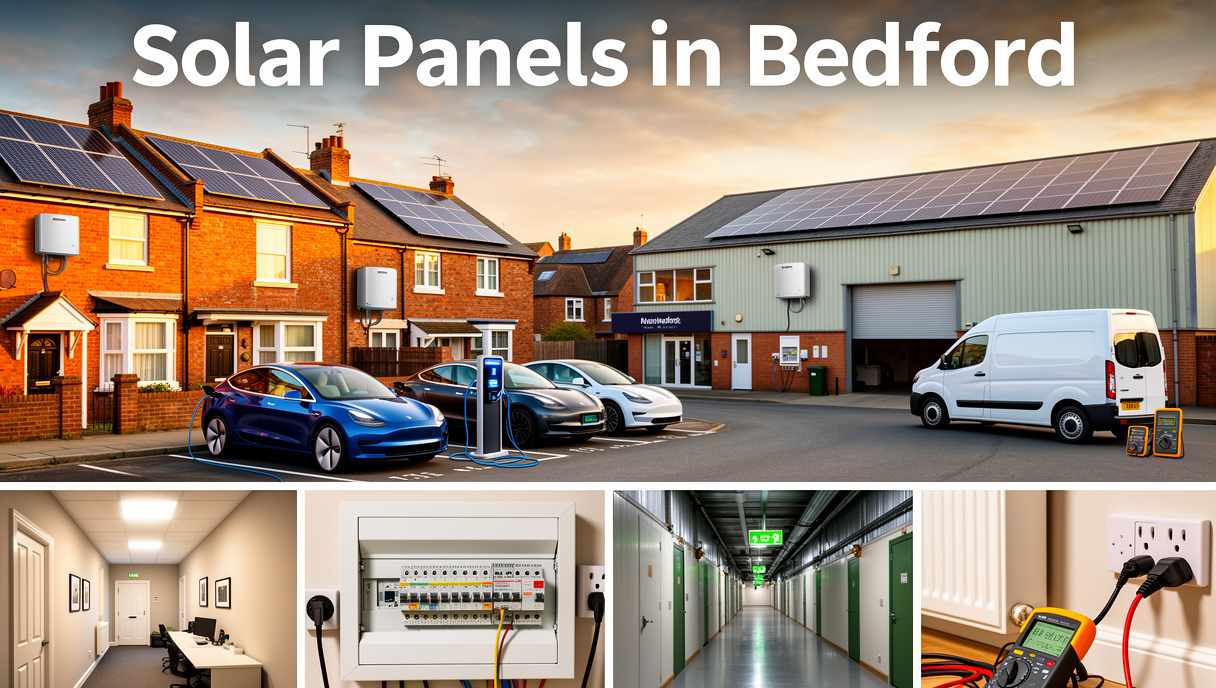
Choosing the Right System: Panels, Inverters, and Battery Storage
Good outcomes start with sound design. Roof size, pitch, shading, and orientation shape the optimal array layout. South-facing roofs still lead on yield, but East–West designs spread generation more evenly across the day, often matching real-world consumption better for families and offices. In Bedford’s residential streets, chimneys and dormers create partial shade; using high-efficiency monocrystalline panels with half-cut cells and, where useful, module-level power electronics (optimisers or microinverters) helps recover performance from these everyday obstacles.
Inverters are the system’s brain. A standard string inverter suits many homes and small businesses, balancing simplicity, cost, and efficiency. Where rooftops have multiple orientations or shading zones, optimisers can improve per-module output and enhance monitoring granularity. Microinverters bring panel-level conversion and are sometimes preferred for complex arrays or where DC cabling lengths need minimising. In the UK, grid connection rules matter: systems exporting up to 16A per phase (around 3.6–3.7 kW on single phase) typically follow a G98 process, while larger exports require a G99 application. A local, accredited electrician will advise on the best route and manage DNO notifications to keep everything compliant.
Battery storage unlocks the next level of value. A 5–10 kWh battery is common for Bedford homes, soaking up midday production and covering evening peaks. Smart controls align charging with sunshine or cheap-rate windows, then discharge when tariff prices rise. For businesses with daytime loads, batteries can flatten peaks and support resilience. Many owners also add an EV charger to turn surplus solar into cheap transport miles. When selecting a system, consider warranty terms (often 10–12 years for inverters and batteries, 20–25 years for panel performance), serviceability, and whether you’d like an EPS/backup circuit for critical loads during outages.
Quality components and professional installation pay dividends for decades. Look for MCS certification to access SEG tariffs and ensure products meet UK standards. Thoughtful cable routes, robust mounting that respects Bedford’s common roof types (concrete tiles, slates), and tidy electrical integration make the difference between a good system and a great one. Equally key is right-sizing: oversizing the array slightly relative to the inverter can boost annual yield at low light levels, while ensuring the battery aligns with your actual consumption pattern prevents unnecessary spend.
Local Installation, Maintenance, and Real-World Results in Bedford
From initial survey to handover, a transparent, local-first approach simplifies going solar. The process typically starts with a site visit or detailed remote design, assessing roof structure, shading, and consumer unit condition. Accurate yield modelling uses Bedford’s local irradiance data and your usage profile to forecast savings. Professional teams then coordinate scaffolding, mounting, electrical works, commissioning, and DNO paperwork. You’ll receive a handover pack with datasheets, warranties, electrical certificates, and guidance for monitoring apps so you can track performance day to day.
Ongoing care is minimal but valuable. Panels are largely self-cleaning in Bedford’s climate, though an annual visual check and occasional clean can help maintain top performance—especially near trees or busy roads. Inverters and batteries are low-maintenance; reputable installers provide periodic inspections, firmware updates, and rapid fault finding if an alert appears in the monitoring app. For commercial sites, planned maintenance dovetails with other electrical compliance like EICR or emergency lighting checks to minimise downtime and consolidate visits.
Local examples illustrate what’s possible. A three-bedroom semi in Putnoe with a 4.2 kWp array, hybrid inverter, and 7 kWh battery can typically cover most spring and summer electricity demand and make serious inroads in winter. Many households see 60–80% self-consumption with a battery, improving payback while keeping evening routines powered by stored sunshine. Over a year, generation in this range can reach several thousand kWh, with savings strengthened by smart tariff use and SEG export income. For small offices in Kempston, an East–West 10 kWp system might offset core daytime loads—computers, HVAC fans, lighting—cutting peak demand and stabilising energy budgets. Light industrial units and warehouses often scale to 30–100 kWp, where roof area and daytime operations align well; here, solar trims energy intensity per unit produced and supports ESG targets.
What truly distinguishes successful projects is integration. Modern systems combine solar panels, battery storage, EV charging, and intelligent controls to create a cohesive, future-ready setup. A Bedford-based electrical team with experience across domestic, commercial, and industrial environments can advise on phased upgrades—perhaps starting with panels, then adding a battery when tariff or lifestyle changes make it compelling. For property owners comparing options, local knowledge of roof types, grid constraints, and planning nuances avoids surprises and keeps timelines tight.
Residents and businesses ready to explore options can learn more and book a survey through a trusted local specialist delivering Solar Panels in Bedford. With the right design, high-quality components, and accredited installation, Bedford properties can lock in lower bills, enhance resilience, and make a measurable contribution to a cleaner energy future—right from their own rooftops.

Prague astrophysicist running an observatory in Namibia. Petra covers dark-sky tourism, Czech glassmaking, and no-code database tools. She brews kombucha with meteorite dust (purely experimental) and photographs zodiacal light for cloud storage wallpapers.